

Case Description
Janak Ram v. The State
Calcutta High Court
Case Type: Criminal Revision Petition
Case No: CRR/29/2023
Date of Order: 01.03.2024
Bench: Jay Gupta, J.
Facts:
- A police team, consisting of the victim police constable, went to Lall Tikrey to maintain law and order in the eve of Durga Puja. There, they received information of a person who was creating nuisance in the area. When they apprehended the miscreant, a few members of the police party took the miscreant to police station while the aggrieved woman along with the rest stayed back.
- As they stood in a dark area, all of them decided to go under the streetlight in front of a shop. When they reached the spot, the accused petitioner (who was also there) allegedly asked the respondent, “Kya darling challan karne aai hay kya?”.
- On this, a complaint under Section 354A and 509 IPC was registered, and the accused was arrested. However, he was subsequently released on bail at the police station. The charge sheet was submitted, charges were framed, and the accused pled not guilty.
- A trial was conducted with 11 prosecution witnesses (belonging to the police force). The accused was convicted on the charges and sentenced to simple imprisonment of 3 months and a fine of Rs. 500 each on both offences. In default, the accused was directed to suffer imprisonment of 15 more days.
- The accused filed an appeal before Additional Session Judge, but it was dismissed. Aggrieved, he filed a petition in High Court.
Issue
- Whether the use of term “darling” constitutes an offence under section 354A(1)(iv) and 509 IPC?
Laws Involved
- Section 354A and 509 of the Indian Penal Code 1860 (“IPC”)
Petitioner’s Arguments
- The impugned order of conviction and sentence suffered from complete perversity. He argued that the time of occurrence was left blank in the FIR, and PW-5 (an independent witness from the police force) stated that the accused had jokingly used such words.
- It was argued that demeaner and tenor of the accused would not attract the application of Section 354A (1)(iv) and 509 IPC.
- Further, petitioner’s counsel highlighted that the aggrieved woman deposed that she felt humiliated as she was in uniform. It appears from the evidence of police personnel that there was a question of clash of egos.
- Some witnesses’ accounts were mere hearsay, and they kept improving their versions of the incident before the police. Moreover, deposition of police constable at the scene revealed that there were other people present, but still no independent witnesses were examined.
- The petitioner’s counsel submitted that the Court did not consider the application of Probation of Offender’s Act and took a rigid stand.
- In furtherance, the words uttered were not obscene; they were inappropriate. So, they do not attract application of Sections 354A (1)(iv) and 509 of IPC.
- The allegedly offensive word “darling” was not a sexually coloured lewd remark. It was a commonly used colloquial word that is often used in movies and films and need not have a sexual innuendo. Even if it is assumed that it has a sexual tone, it could not be said that the word was used with an intention to insult modesty.
- Lastly, the counsel argued that the punishment awarded was very harsh, and despite the presence of an alternative punishment of fine, the appellant was awarded 3 months of imprisonment out of one-year’s maximum tenure provided under the said section.
Respondent’s Arguments
- The scope of interference by the Hon’ble Court for revision against acquittal was very low as the impugned orders were well reasoned.
- Adequate punishment was rewarded for the nature of offence committed.
- There was no proof of acquaintance between the parties that would justify such remark.
- The prosecution proved the case beyond reasonable doubt.
Court’s Analysis
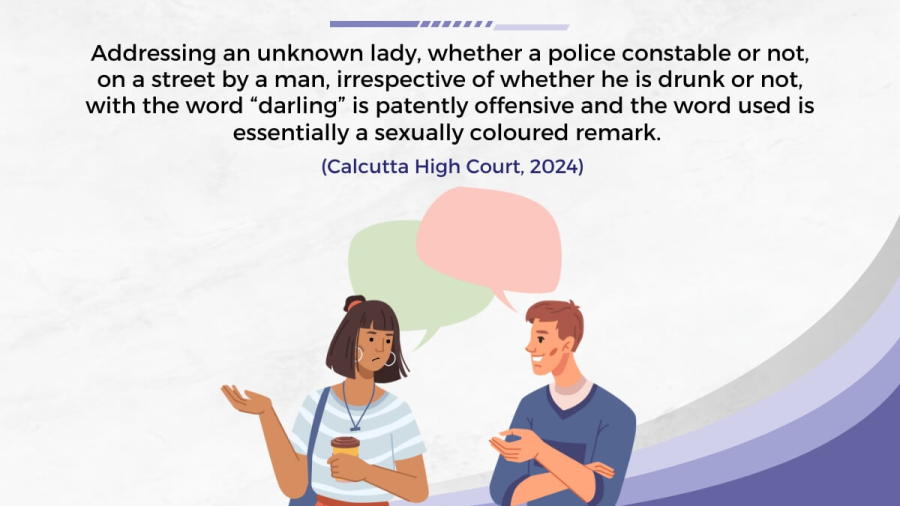
- Sexually coloured remarks are penalized under section 354A IPC. Addressing an unknown lady, whether a police constable or not, on a street by a man, irrespective of whether he is drunk or not, with the word “darling” is patently offensive and the word used is essentially a sexually coloured remark.
- Section 509 deals with words, gesture or acts intended to insult the modesty of a woman. Using such expression to an unacquainted lady cannot but be an act intended to insult the modesty of the addressee.
- As prosecution primarily based itself on the statements of the police personnels, it is a must to carefully analyse them and ensure that no false implications were made. Taking the statement of all witnesses as a whole, it can be seen that not all witnesses deposed in the same sense. For instance, PW-5 stated that the accused said the line jokingly and PW-9 deposed that his eyesight is not good. Thus, the possibility of the case being a frame up is precluded.
- The given circumstance rules out the need to examine a local person or an independent witness to support prosecution’s arguments. Non-availability of such independent witness was nothing abnormal since the incident happened near a streetlight quite away from the shop.
- On question of sentence, the Court opined that aggravating and mitigation circumstances should be carefully weighed. The punishment should not be a fleabite, but an adequate one. It was observed that the appellant did not aggravate the act further. Hence, there is a need for reconsidering the sentence.
Conclusion
- The Court held that the circumstances brought out in evidence during trial clearly establish prosecution’s case beyond doubt, and after two criminal Courts concluding same about the culpability, it did not find any exceptional reason to set aside the conviction.
- Considering the nature of the offence committed, it involved an act of moral depravity committed against a woman. Therefore, the Courts were right in not invoking the provisions of the Probation of Offenders Act. The Hon’ble Bench relied on Gita Ram and another vs. State of H.P, (2013) 2 SCC 694 to substantiate this conclusion.
- The Hon’ble Judge modified the sentence to the extent that the appellant is to undergo a simple imprisonment of one month for committing each offence and both the sentences would run concurrently. The petitioner was directed to surrender before the learned Trial Court to serve the sentence.