

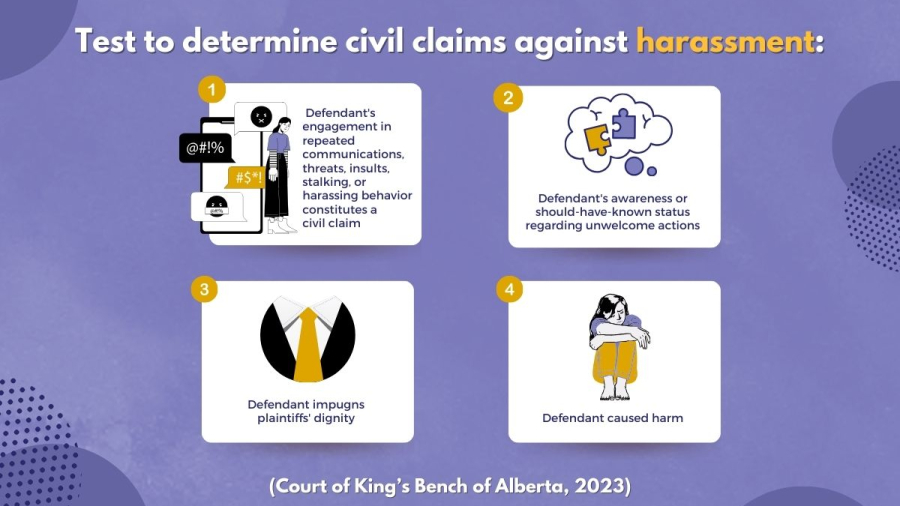
In one of its kind rulings in Canada, contrary to the law laid down in Ontario on harassment as a tort, a Judge in Alberta laid down a test to determine civil claims against harassment in Albert Health Services v Johnston, 2023 ABKB 209 (Order dated 12 April 2023).
Facts
In 2021, the Defendant, Y was running as a mayoral candidate in Calgary. Throughout his political campaign, a lot of misinformation, conspiracy theories and hateful statements were made by him. Particularly, his comments frequently targeted the Plaintiff, X and one of their female employees for enforcing public health orders during Covid-19 pandemic. He called the employees of X terrorists and fascists while mocking her and her family.
Following his remarks, X obtained an interim restraining order against Y and later sued Y for his defamatory statements, assault and harassment.
Issues
- Whether an unselected public body like AHS can bring a claim of defamation?
- Whether harassment is a recognised tort in Alberta?
Judge’s Analysis
Under Canadian law, a democratically elected government body cannot bring a suit for defamation. This law is made with the intention of ensuring that individuals can criticise the government without a fear of lawsuit.
Citing certain precedents, the presiding judge held that Albert Health Services is a public body and thus cannot sue for defamation. Even though X’s board of directors had not been elected democratically, they were however appointed by the Minister of Health and served under the same ministry.
Relying on Regional Health Authorities Act, RSA 2000, the enabling act of AHS, the judge identified X to be a government body whose decisions could be overturned by the government at any time amongst other things.
On the tort of harassment, the judge highlighted that such a tort does not exist in Alberta. The judge noted that there exists a gap in the law and laid down that existing torts do not address the harm caused by harassment.
On analysing the case and elements of existing torts, the Court ruled that harassment would be a recognised tort in Alberta and laid down the following test for the same-
- If the defendant is engaged in repeated communications, threats, insults, stalking or other harassing behaviour in person or through other means.
- If the defendant knew or ought to have known was unwelcome.
- If the defendant impugns the dignity of the plaintiffs.
- If the defendants caused harm.
Judgement
Justice ruled that Y had engaged in the tort of harassment and as such awarded the employee a total of (1) $300,000 damages for defamation; (2) $100,000 damages for harassment; (3) $250,000 for aggravated damages.
It was also held that X though did not have sufficient cause of action against Y, but fulfilled its duty as an employer and acted on behalf of its employees and provided a safe working space.
About The Legal Swan: We are an organization that aims to provide 360-degree solutions against bullying, harassment & discrimination and promote diversity, equity, inclusion & belonging. For any queries, consultation or services, get in touch with us connect@thelegalswan.com or +91 90040 99796.
Authored by Isha Khorana, Legal Intern