

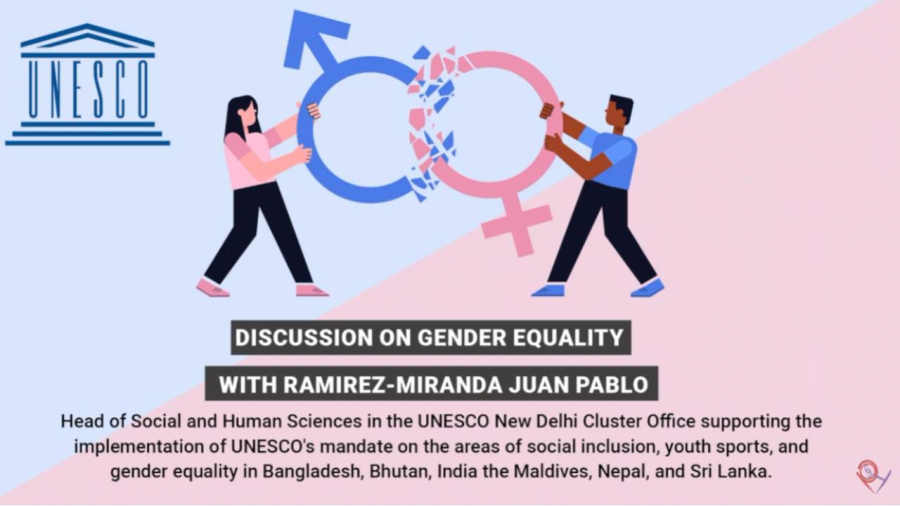
Discussion with Juan Pablo from UNESCO on gender equality on aspects such as key initiatives/steps being taken by UNESCO to achieve gender equality, needs of different genders and meaning of ‘Equality’ & ‘Equity’.
Juan Pablo Ramirez Miranda currently serving as Head of Social and Human Sciences in the UNESCO New Delhi Cluster Office supporting the implementation of UNESCO’s 🌎 mandate on the areas of social inclusion, youth, sports, and gender equality in Bangladesh, Bhutan, India, the Maldives, Nepal, and Sri Lanka. Following an early career in research and educational psychology, he joined UNESCO in 2012. At its Headquarters, he has supported UNESCO’s work on Education for Sustainable Development and Global Citizenship Education, including the global monitoring of Target 4.7 of Sustainable Development Goal 4 on Education, and its related standard-setting instrument. He had also been seconded to UNESCO’s Governing Bodies (Executive Board and General Conference) as Deputy-Secretary and Speechwriter, working for their commissions dealing with financial, administrative, and external relations matters. In the field, he served in Viet Nam and Costa Rica, respectively as Executive Officer to the Director and implementing programs related to education, social inclusion, #humanrights, #genderequality, youth, and the rights and empowerment of people of African descent. Points discussed between Juan Pablo and Shivangi Prasad on gender equality are mentioned below- 1) What are some of the key initiatives/steps being taken by UNESCO to achieve gender equality? 2) Different genders may have different needs which may be the result of various factors. In this respect, how do you see ‘Equality’ & ‘Equity’? 3)In our experience, several women state that they do not feel men can understand their difficulties and challenges. Several women also say that when men talk about equality and women rights, they are applauded and when women do so, they are typecasted as people having an agenda – In your experience, is this about any particular gender, or do you think this is more of a ‘human rights’ matter and a cause of concern for everyone? What are some of the ways in which stereotypical notions can be done away with? At #UNESCO, are you taking any initiatives to involve all genders towards this work? 4) How does youth play a role in all this? 5) What are your views on gender & intersectionality? Do follow us for more updates 😊