

Case No.: Dr. Sohail Malik v. Union of India & Anr. arising out of W.P.(C) 8624/2023 & CM APPL. 32735/2023, CM APPL. 32736/2023
Court: Delhi High Court
Date of Order: 30.06.2023
Bench: Hon’ble Mr. Justice C. Hari Shankar; Hon’ble Mr. Justice Manoj Jain
Reference
- X was the Complainant in the complaint before the Internal Committee, Respondent before the Central Administrative Tribunal, and Respondent in the instant case.
- Y was the Respondent in the Complainant before the Internal Committee, Petitioner before the Central Administrative Tribunal, and Petitioner in the instant case.
Facts
The facts of the case are as follows:
- X submitted a complaint to the IC (Internal Committee) of her own department, i.e., the Department of Food & Public Distribution, Ministry of Consumer & Public Distribution, wherein it was alleged that Y, an IRS officer had sexually harassed X.
- However, Y moved the Central Administrative Tribunal challenging the jurisdiction of X’s ICC to examine the complaint, which was eventually rejected and dismissed.
- Aggrieved by it, Y filed the present writ petition, challenging the order of The Tribunal.
Issue
The issue that came up before the court was whether the Complainant’s IC would have the jurisdiction to issue notice and conduct inquiry when the Respondent works for a different employer?
Y’s contention on the issue
Some of the key contentions raised by Y on the aforementioned issue as are follows:
- IC of one department cannot conduct an inquiry against an employee (respondent) of another department.
- IC report is to be submitted to the employer. Accordingly, as per Section 2(g), the employer would be X’s Head of Department, who does not have disciplinary control of Y’s department.
Law
- An IC is constituted pursuant to Section 9 of the SHW Act, 2013.
- IC has the power to summon and enforce the attendance of any person and examine them on oath; under Section 11(1) of the SHW Act 2013.
Analysis
- The Court relying on Shailesh Dhairyawan v. Mohan Balkrishna Lulla & Richa Mishra v. State of Chhattisgarh stated that the golden rule interpreting statues in their plain meaning has been replaced by the rule of purposive construction.
- The Court, thus stated that SHW Act, is a social welfare legislation and its interpretation should not dilute or defeat its purpose i.e., providing a safe working environment.
- On Y’s contention, the Hon’ble Court pointed out that such an interpretation would strike at the very root of the SHW Act and its ethos and philosophy.
- As for section 11(1), the bench observed that the provision does not restrict its application in cases where the respondent is an employee of the other department.
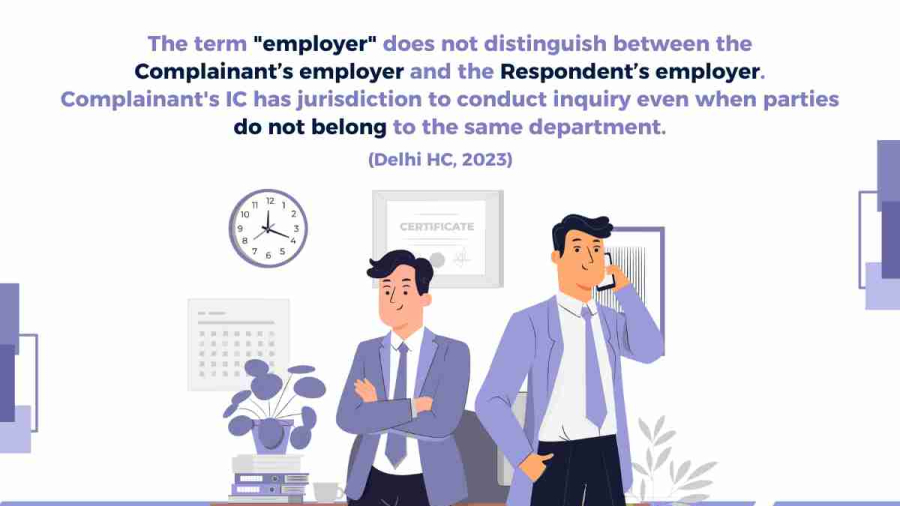
- The IC is required to forward its report to the employer. The Act does not define the term employer to mean the Respondent’s employer. The term employer has been defined under the Act in such a way that it does not distinguish between the Complainant’s employer and the Respondent’s employer.
Conclusion
The Hon’ble High Court upheld the order of the learned Tribunal and dismissed the writ petition in limine.
Written by: Isha Khorana, Intern