

In this beautiful judgement, the Madras High Court observed and opined on the need for gender sensitization awareness and training programme. It analysed three petitions and highlighted the failure of POSH implementation at institutional levels.
Case Description
X v. State
Madras High Court
Case Type: Writ Petition
Case No.: W.P.(MD)Nos.13981, 9747 & 12601 of 2024 and WMP. (MD) Nos. 12247 of 2024
Date of Order: 21.11.2024
Bench: R.N. Manjula, J.
Facts
Three different petitioners filed three writ petitions highlighting their institution’s insensitivity to complaints of sexual harassment in their workplace.
W.P. (MD) 9747/2024
- Petitioner 1 (“P1”) filed a complaint of sexual harassment against Respondent 5 (“R5”) to whom she reported as per the instructions of Respondent 3 (“R3”). However, R3 did not take any action against R5. Instead, he questioned the Petitioner on her action of lodging the complaint.
- Since the institution failed to constitute an Internal Committee (“IC”) to inquire into her complaint, she proceeded to file a police complaint.
- P1 filed a writ petition to address the absence of an IC inquiry at her workplace that is mandatory under Section 11 of POSH Act despite the representation she made on 26.10.2023.
- Through the writ petition, she sought court’s direction obligating Respondent 1 (“R1”) and Respondent 2 (“R2”) to form an independent committee and take disciplinary actions against R3 and R5.
W.P. (MD) 13981/2024
- Petitioner 2 (“P2”) held additional charge of Residential Medical Officer (RMO) subsequent to R5’s arrest. After assuming charge, she took cognizance of similar complaints made by interns and students of the institution against a Lab Attender and R5.
- R3 did not support her action. He placed the P2 under suspension, citing receipt of a third-party complaint against her. Therefore, she filed a writ petition to challenge the order of suspension.
- P2 complained of the instances of sexual harassment to the Head of the Department. He took pro-active actions against the issues. R3 called the Department Head and blamed him for not reporting the incidents on time. Further, he directed the in-charge to appear for an inquiry initiating from a third-party complaint.
- The Department Head filed a writ petition seeking Government’s appointment of an inquiry officer to look into the matter. Accordingly, Government appointed an Inspection Team. The team vindicated P2 from all charges and recommended revocation of her suspension.
- Additionally, the team stated that R3 had given false statements and that there was no prima facie ground for P2’s suspension.
- Noting the gross institutional insensitivity towards complaints of sexual harassment of women at workplace, the Court impleaded the State, the Union Government, State and National Women’s Commission as parties.
W.P. (MD) 12601/2024
- During the lockdown, Petitioner 3 (“P3”)— a ministerial staff— did not go to her officer because her profession did not fall in the category of essential department, and she was not provided with transportational facility.
- On 25.01.2021, she was issued a show cause notice for why her salary should not be withheld. On 10.05.2021, she was given a charge memo stating that she has been on an authorized leave from 10.05.2021 to 06.06.2021.
- In her response to the memo, P3 stated that she could not stay at the headquarters and that the Divisional Manager harassed her with unparliamentary words with sexual connotations. But no heed was paid to her concern, and she was punished with withholding of increment for one year.
- P3 filed a sexual harassment complaint against the Divisional Manager before the IC. The IC findings mentioned that she had filed a false complaint and imposed her with the punishment of stoppage of increment for two years.
- P3 preferred an appeal but it was rejected. The rejection confirmed the punishment order. Therefore, she filed a writ petition, challenging the order of punishment.
Issues
- Whether gender sensitization initiatives are a part of POSH Acts and Rules?
- Whether the POSH Act contemplates promotion of gender sensitivity as a responsibility of the employers?
- Whether a POSH complaint, concluded as unsubstantiated, be treated as a false complaint without further inquiry?
Laws Involved
- Sexual Harassment of Women at Workplace Act (Prevention, Prohibition and Redressal), 2013 (“POSH Act”)
- Protection of Children from Sexual Offenses Act, 2012 (“POCSO”)
Court’s Observation and Analysis
Regarding False Complaints
- According to Section 14 of POSH Act, IC may recommend action against a woman in accordance with service rules if it is found that she maliciously filed a false complaint.
- The usage of the term ‘may’ within the provision clarifies that such recommendations are discretionary and not mandatory.
- IC can only utilize this provision if it is proven during the inquiry that the Complainant knowingly and intentionally filed a false complaint. If IC makes such recommendation without inquiring into her intent and recording it in the findings, the recommendation becomes illegal to that effect.
- Often, Complainants do not have sufficient proof or witnesses to corroborate her allegations due to the threat to their job security or retaliation at workplace. They cannot expect their colleagues to come in their support for they may fear the same consequences.
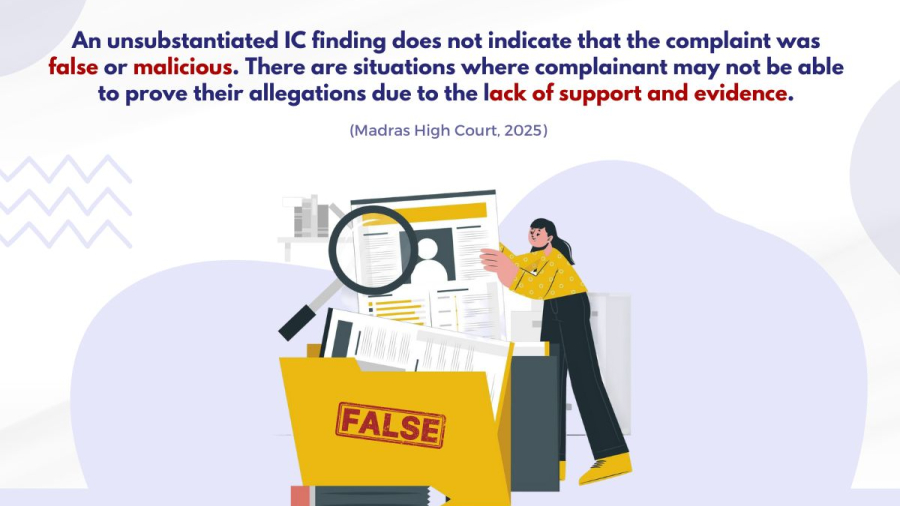
- An unsubstantiated IC finding does not indicate that the complaint was false or malicious. There are situations where complainant may not be able to prove their allegations due to the lack of support and evidence.
- To conclude that the complaint was false or maliciously filed, IC must grant the opportunity to the Complainant to defend her case. The Complainant, or person submitting the complaint on her behalf, must be notified and allowed to make submission.
Also read: Case Study on ‘What if I Lose My Job?’
Regarding Gender Sensitization
- POSH Rule 13 obligates employers to promote gender sensitive safe spaces and remove factors that contribute towards a hostile work environment for women.
- The Statement of Objects and Reason of the POSH Act state that sexual harassment at workplace is violation of a women’s right to equality, life and liberty. It creates an insecure and hostile workplace and discourages women’s participation in workforce. This negatively impacts women’s social and economic empowerment and inclusive growth.
- Under POSH Act, employers have the responsibility to organize workshops and awareness programmes to sensitize employees and to impart orientation programmes for IC members.
- The term ‘sensitization’ has to be read and understood with objects of the Act. Sensitization should not be limited to employee sensitization about POSH provisions. It should be a wholistic sensitization where employees are sensitized to understand the justification for women’s right to equality.
- There is no assessment mechanism to evaluate whether an appointee has the gender sensitivity required to maintain harmony with the other gender at workplace.
- Unless gender sensitivity assessment is made on people awaiting promotions in workplace, it is difficult to prevent misogynists from occupying top positions in the organizations.
Also Read: SC directions on POSH Survey
Regarding Sex Education for School Students
- There is lack of sex education for children in India. This leads them to find more information on the subject from exploitative resources. For generations, children are told that sex is a shameful topic and should not be discussed.
- After implementation of POCSO Act, children are made aware of safeguard mechanisms against exploitation. However, the Act fails to educate them about decision making in matter of sex.
- As these children become adults, their deviant and aggressive behaviour reflects in their interaction with the other sex. Therefore, they should be given sex education at the initial stages itself to avoid the damage that they might cause to the society in future.
Regarding Government’s Shortfall in Tackling Gender Discrimination
- There is a lack of Government recognized or sponsored High Power Technical Committee to assists establishments with customized modules, personalized for respective institutions, for imparting awareness and conducting trainings on gender sensitization.
- The Supreme Court has delivered guidelines from Vishakha v. State of Rajasthan to Aureliano Fernandez Vs. State of Goa and others on strict implementation of POSH Act. Although it is not fair to state that there is absence of intention in government machineries to implement the guidelines, but there is presence of inherent indifference to it.
Court’s Direction
The Hon’ble Court gave the following directions:
- The State Women Commission to submit a copy of new draft rule within 2 weeks of the order. The State Government shall scrutinize the same and make feasible amendments before its approval and publication. A report to be submitted to the court in the next hearing.
- The State Government shall submit a detailed report on gender budgets and gender cell mechanisms. Further, the State Women Commission is directed to create awareness regarding availability of gender budget cell in each department.
- The State Government shall form a State Level Technical Committee, with professionally qualified individuals in field of gender and skills to prepare module and evaluation questionnaire, for Gender Sensitization awareness and training programs.
- All Government Respondents and Women Commissions at both levels are directed to offer suggestions to compel gender sensitization for all employees, new or seasoned, and for those availing government’s services. Additionally, it also has to provide suggestions on ways to prevent people, who are paid with public money, from indulging in gender discriminatory acts like sexual harassment of women at workplace.
- The Government Respondents are also directed to file a feasibility report on:
- Inclusion of gender sensitization questionnaire in competitive government job exams.
- Mandating qualification in department and institution specific gender sensitivity test, along with departmental account papers, for promotions or increments.
- Inclusion of period assessment of gender sensitivity to curb misogynistic tendencies in managerial positions.
- Mandating gender sensitivity clearance certificate, issued by appropriate technical authorities, as a condition to obtain license to carry out business, profession, to register marriage, etc. wherever incidence of paid or unpaid care work or employment arise and to amend the respective rules accordingly.
- Formation of gender audit squad to inspect workplaces and assess gender sensitivity in employees.
- Appointment of Central /State /District /Taluk /Village level Technical Authorities (Gender) with qualified and experienced people in the field to oversee implementation.
- Submission of a report on gender sensitization and age-appropriate sexual education for students in schools and higher educational institutions.
Authored by Ayush Bardhan, Legal Associate