

Case Brief
Name of Court: High Court for the State of Telangana, at Hyderabad
Parties: Megha Sarmah v. State of Telangana & Ors.
Case No.: W.P. Nos. 6031 & 6598 of 2023
Date of Order: 10.03.2023
Bench: Hon’ble Sri Justice J. Sreenivas Rao
Facts:
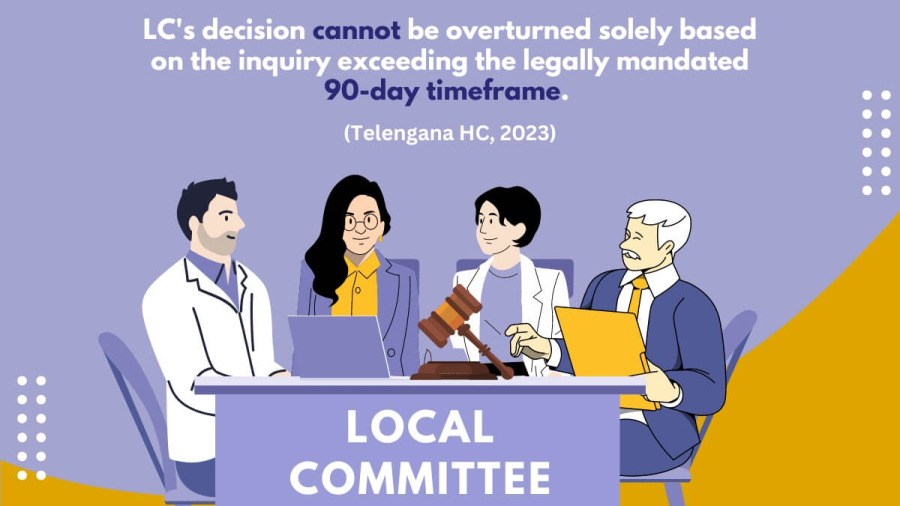
X (Petitioner in W.P. No. 6031/2023; Respondent No. 3 in W.P. No. 6598/2023) had raised a complaint of sexual harassment against Y (Petitioner in W.P. No. 6031/2023; Respondent No. 3 in W.P. No. 6598/2023) before the local committee, i.e., A. However, A failed to complete the proceedings within the legally stipulated time specified under the Sexual Harassment of Women at Workplace (Prevention, Prohibition & Redressal) Act 2013 (‘POSH Act’).
X filed a writ petition before the High Court challenging A’s actions as arbitrary, unconstitutional and in violation of the POSH Act.
Y also filed a writ petition before the High Court challenging A’s actions of insisting that Y resolve the matter with X by paying monetary compensation to X.
The writ petitions filed by both X and Y were clubbed together and were disposed of vide a common order.
Issue:
The issues raised are as follows:
- Whether Local Committee’s actions of not completing the inquiry within 90 days is in contravention of the POSH Act?
- Whether insisting Y to settle the issue by paying compensation along with salary for a period towards X even though FIR is pending on the same set of facts is in contravention of the POSH Act?
Law:
Sec. 10 of the POSH Act deals with conciliation for resolution of sexual harassment concerns between parties.
Analysis:
Regarding Issue 1,
- X argued that though complaint was filed, inquiry was not completed within stipulated time.
- Y argued that he was ill and had requested to adjourn proceedings. However, Y was ready to attend the proceedings before A.
- A argued that they are in strict adherence to the POSH Act.
Regarding Issue 2,
- Y argued that he was directed to settle the matter with X even though FIR was pending before competent court, with same set of allegations.
Conclusion:
The court disposed of both the writ petitions on the following terms:
- A was directed to issue notice to X and Y for conducting inquiry as required under Sec. 10 of the POSH Act by giving a date of inquiry.
- X and Y were noted to be entitled to raise all the objections as available under law.
- A was directed to consider the objections raised by part and pass appropriate orders within a period of ten (10) weeks from the date of the order.
By – Divya R, Trainer & External Member, Chief Quality Officer (Social Media)