

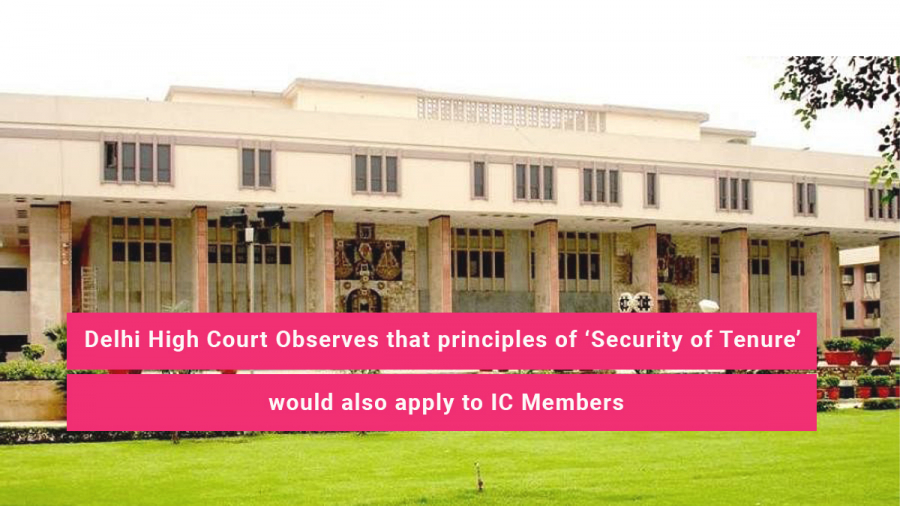
In the matter of Neeraj Bala vs. Union of India & Ors., the Delhi High Court observed on July 19, 2021, that the principles that apply to the security of tenure of judges and presiding officers of various quasi-judicial tribunals would also apply to members and presiding officers of an internal committee (“IC”).
The facts of the case are that Neeraj Bala (“Petitioner”) was a commandant at Central Reserve Police Force (“CRPF/Respondent”) Dwarka and was also appointed as the Presiding Officer of the Sector Level IC. A complaint against DIG was brought to the IC. The IC gave findings that were against the DIG. She was transferred after this before completing her 3-year tenure (as per POSH Law). Accordingly, she filed a writ petition in the Delhi High Court challenging her transfer order.
The respondent contended that there is no hard and fast rule regarding the 3-year tenure, and for administrative exigencies, officers and personnel can always be transferred.
The Court held that:
- When an officer, by virtue of a post, is also a presiding officer or member of the IC, ordinarily there should be security of tenure.
- The principles that apply to the security of tenure of judges and presiding officers of various quasi-judicial tribunals would also apply to members and presiding officers of the IC.
- In coming to this conclusion, the Court also referred to the decision of the Supreme Court in Madras Bar Association vs. Union of India (2014) 10 SCC 1. It said that all courts are tribunals; any tribunal to which any existing jurisdiction of the court is transferred should also be a judicial tribunal, meaning, inter alia, that the members of the tribunal should have the independence and security of tenure associated with judicial tribunals. In this regard, the Court also referred to Section 11(3) of the POSH Law and said that for the purpose of making an inquiry, the IC has the same powers as those vested in a civil court under the Code of Civil Procedure, 1908 (for summoning and enforcing the attendance of any person, examining him on oath, and requiring discovery and production of documents).
- Accordingly, the court also said that the presiding officers and members of the IC are also ‘judges’ within the meaning of Section 19 of the Indian Penal Code, 1960. Section 19 of the Indian Penal Code states that “the word “judge” denotes not only every person who is officially designated as a judge but also every person who is empowered by law to give, in any legal proceeding, civil or criminal, a definitive judgment, or a judgment which, if not appealed against, would be definitive, or a judgment which, if confirmed by some other authority, would be definitive, or who is one of a body of persons, which body of persons is empowered by law to give such a judgment.”
- Responding to the contention of the respondent on transfer due to administrative exigencies, the Court said that the transfer was punitive in nature, and when a personnel or officer by virtue of a post also occupies the position as aforesaid, the administrative exigencies have to be weighed vis-à-vis the consideration of the need for security of tenure, inasmuch as, otherwise, there would always be “apprehension that on returning unfavourable findings, the sword of transfer would be brought down.”