

Corporation of the City of Calgary v Amalgamated Transit Union, Local 583, 2023 CanLII 20867 (AB GAA)
Date – 7th March 2023
Arbitrator – James T. Case, K.C
Beyond office Hours: Employer’s right to bring disciplinary action against off-duty misconduct.
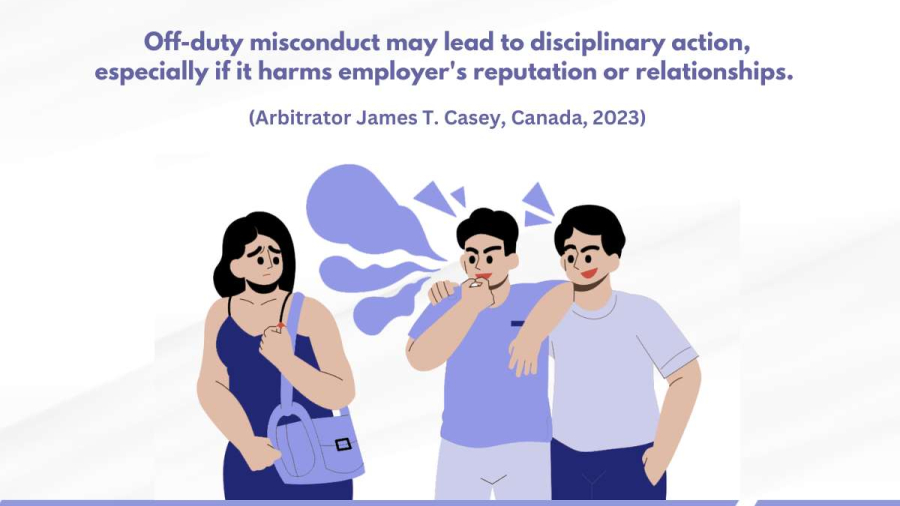
As an employee, even your inappropriate off-duty conduct can have a direct bearing on employment relationships. Especially in cases where the employer’s reputation is likely to get harmed by the actions of its employees.
Facts:
Two co-workers, A and B, worked for the City of Calgary as transit operators. The two co-workers took a car for a test drive, which B was interested in buying. While driving, A held B’s hand without her consent and suggested that they should be “friends with benefits”, to which B denied. After the test drive, A dropped B home in his car. When B went for a hug, A touched her inappropriately.
Although B did not report the incident, it eventually came to the attention of her supervisor during a casual conversation. The employer i.e., the City of Calgary became aware of the incident and conducted an investigation. Upon a thorough investigation, they found B’s evidence was clear and concise, and A’s employment was terminated.
Arbitration Proceedings:
The Union filed a grievance on behalf of A. During the Arbitration Proceedings, A maintained his stance that he did not do or say anything that would insinuate having a physical relationship with her.
The case of the A was as follows:
- The credibility of opposing testimony, as only two parties were present during the incident.
- Whether off-duty conduct, even if found to be inappropriate, would justify the employer’s interest to justify a disciplinary action?
- Even if there was misconduct, termination was an extreme punishment given to A. On the contrary, a lengthy suspension would have been a sufficient punishment.
The Reasoning of the Arbitrator:
On assessing the credibility of the witnesses, the arbitrator noted B gave a clear and concise testimony without any inconsistencies during her direct examination & cross-examination. Through the evidence provided by the parties, the arbitrator concluded that there was no motivation for B to make any false allegations. While concluding A’s credibility, the arbitrator analysed the transcript of his investigative interview and his testimony during the arbitration and found that A was ready to lie in order to protect his job.
Citing, Brown & Beatty, the arbitrator highlighted that certain activities such as SH even in off-hours will have a direct bearing on most employment relationships and may even result in dismissal. As per “The Milhaven Fibers’ test for determining employers’ disciplinary response in off-duty conduct, the arbitrator noted any one criterion may justify disciplinary action. The criteria to establish harm to the employer’s company reputation by Grievors does not require evidence of such effect and the arbitrator can use their fair-minded judgement. The arbitrator concluded that such conduct had a detrimental effect on the reputation of the company, hindering A’s ability to perform his duties as a transit operator and causing other female coworkers discomfort in working with him.
Considering the seriousness of the misconduct, the impact of misconduct on B amongst several factors, the Arbitrator concluded that the termination of employment was not an excessive response.
Written by – Isha Khorana