

Case Description
Vaneeta Patnaik v. State of West Bengal & Ors.
Calcutta High Court
Case Type: Writ Petition
Date of Order: 22nd May 2024
Bench: Kausik Chanda, J.
Facts
- The petitioner, who was the complainant before the Local Committee(“LC”), formerly known as the Local Complaints Committee (“LCC”), had filed a complaint with the LC under the Sexual Harassment of Woman and Workplace (Prevention, Prohibition and Redressal) Act 2013 (“Act”) on 26.12.2023. After receiving the complaint, LC issued a notice to the respondent seeking his reply. The respondent filed his response where he denied the allegation.
- On 05.03.2024, the petitioner filed an application for condonation of delay, but the LC issued an order and rejected the complaint citing expiration of limitation period.
- As per LC’s reasons for decision, the last alleged “sexual harassment” happened within 30th April 2023; the incidents which followed up to December 2023 did not fall into the category of sexual harassment as defined under S. 2(n) of the Act.
- Since the complainant filed the complaint on 26.12.2023, the limitation of 3 months (enshrined in Section 9 of the Act) had expired.
- Moreover, the LC did not find the petitioner’s application for condonation of delay as satisfactory because it could not find any circumstance on it which prevented her from filing the complaint on time. Hence, the LC unanimously rejected the complaint.
Issues
- Whether the complaint filed by the petitioner is within the limitation period under the Act, and if so, whether the order passed by the Local Committee is unsustainable?
Laws Involved
- Sections 2(n), 3(2) and 9 of the Sexual Harassment of Woman and Workplace (Prevention, Prohibition and Redressal) Act 2013.
Petitioner’s Arguments
- The petitioner’s counsel submitted that the LC solely relied on the definition of sexual harassment given under Section 2(n) of the Act and did not take into consideration the definitions provided under Section 3(2).
- It was argued that had the LC read the complaint as a whole, it would have observed that the petitioner had alleged several incidents of implied or explicit threat of detrimental treatment in her employment.
- Moreover, the petitioner had also submitted to the LC the instances when the Respondent 7 (respondent in sexual harassment complaint before LC) interfered with her work and created a hostile work environment. In furtherance, she had also mentioned about being subjected to humiliating treatment affecting her health and safety.
- The counsel emphasized that the committee did not take these into account, along with the definition under Section 3(2) of the Act, and erroneously rejected the petitioner’s complaint on ground of limitation.
University’s Argument
- The counsel appearing for university supported the finding of the LC and submitted that nothing alleged in the complaint happened after April 2023, in connection with any act or behaviour of sexual harassment.
- It was argued that the LC had passed its decision after duly analysing the petitioner’s complaint and the documents produced before the committee with the reply of the respondent. Therefore, the court should not interfere with LC’s decision.
Respondent 7 (Respondent in sexual harassment complaint before LC)’s Argument
- It was pointed out by respondent 7’s counsel that the petitioner herself had filed an application for condonation of delay. As the LC was not satisfied with the explanation presented by the petitioner, it rightly rejected the complaint.
Court’s Analysis
- The Hon’ble judge perused through Sections 2, 3 and 9 of the Act and concluded that the “circumstances” envisaged in Section 3(2) must occur in relation to or in connection with any act or behaviour of “sexual harassment” within the meaning of Section 2(n).
- While calculating the period of limitation, Section 9 must be interpreted in the context of both Section 2(n) and Section 3(2) of the Act.
- In furtherance, the court went into the details of the petitioner’s complaint:
- Para 8: shortly after 13th September 2019, Respondent 7 had asked the petitioner to go to dinner with him. This happened right before selection proceedings for her promotion to the post of Associate Professor.
- Para 9: On 27th September 2019, he again insisted her to join him for dinner and inappropriately touched her hand.
- Para 10: In October 2019, the Respondent 7 asked the petitioner for sexual favours.
- Para 17: On 16th July 2021, he threatened the petitioner to withhold her promotion for declining the offer to have a personal friendship with him.
- Para 18-19: Petitioner ultimately got promoted on 1st May 2022.
- Para 20: In March 2023, Respondent 7 again offered her a chance to mend their relationship and kept calling her to his office on different pretexts. In April 2023, he asked her to go to Mandarmoni with him; she refused this proposal.
- Para 21: Petitioner narrated incidents of 29th August 2023 where he had made her a scapegoat of an unfinished project and removed her from her position.
- Para 26: Petitioner alleged that the Respondent 7 vindictively drafted the minutes of the meeting to make it appear as if a preliminary enquiry was initiated against her for misutilization of development grants.
- Para 29: The respondent 7 again clubbed the issue of misutilization of fund with another issue in one agenda and circulated it in November 2023 to confuse the Executive Council.
- Para 30-33: Petitioner alleged that she had complained of her harassment and victimization to the Executive Council members on 6th November 2023. When she was asked to meet the members on 27th November 2023, she found the Respondent 7 there. She asked the members for his recusal and Respondent 7 denied it stating that he was the chairman of the meeting. The meeting was deferred to 21st December 2023. Although the petitioner was present in the university till 8 pm on the said date, she was never called for a hearing. In fact, she found out that the Respondent 7 not only did not allow any discussion of her harassment, he also manipulated the Council into appointing a one-man enquiry committee to enquire into the false allegation against the petitioner.
- In the last paragraph, the petitioner mentioned, “In the above circumstances, I am passing my days in fear and apprehension. Since, the Executive Council has refused to look into my complaints, I do not have any other remedy left.”
- After going through the complaint, the learned judged opined that there was a clear nexus between the circumstances of victimization and detrimental treatment occurring between April 2023 to December 2023 and the alleged sexual harassment of the petitioner between September 2019 to April 2023.
Conclusion
- The Court observed that if the complaint is read as whole, it would lead to the conclusion that complaint was well within the limitation of Section 9 read with section 2(n) and 3(2) of the Act.
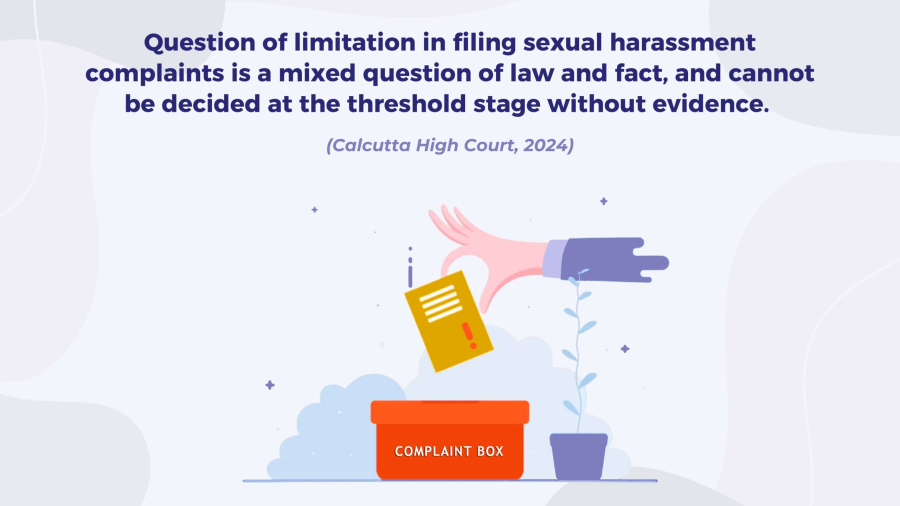
- It was held that the question of limitation is a mixed question of law and fact, and therefore, the LC could not have decided it at the threshold stage without evidence. The Court relied on the case of Urvashiben v. Krishnakant Manuprasad Trivedi [(2019) 13 SCC 372] to substantiate this conclusion.
- Based on the thorough reading of the complaint, the bench held that the order passed by the LC on 05.03.2024 is not sustainable and the same is set aside. Further the LC was directed to conclude the proceedings on the complaint filed by the petitioner on merit and in accordance with the Act.