

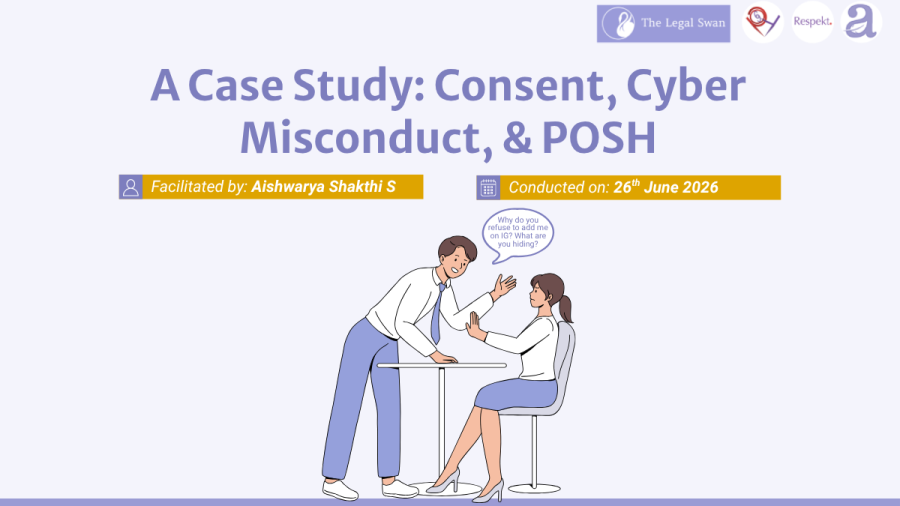
As workplaces become increasingly digital, can conduct outside office premises still fall within the scope of the POSH Act? In Episode 19 of Anvay Insights, A Case Study: Consent, Cyber Misconduct, & POSH, Aishwarya Shakthi S, Trainer & External Member, The Legal Swan (TLS), unpacked these complex questions through a practical case study that challenged conventional assumptions around consent, cyber misconduct under the POSH Act, and the jurisdiction of the Internal Committee (IC).
The rapid shift towards digital communication has blurred the boundaries between personal and professional interactions. Conversations that begin on social media, messaging platforms or dating applications can, in certain circumstances, have implications for the workplace.
Recognising this evolving landscape, Anvay Insights Episode 19 explored how organisations and ICs can navigate cases involving online conduct while remaining fair, legally compliant and survivor-centric.
A Case Study Rooted in Today’s Workplace
The session revolved around a realistic case study involving two colleagues whose personal interactions gradually evolved into allegations of online misconduct. Rather than focusing solely on legal provisions, the discussion encouraged participants to think like IC members, examining facts, identifying relevant evidence and understanding the broader workplace implications.
Through the case study, participants were invited to consider a series of practical questions that organisations increasingly encounter in today’s hybrid workplaces.
Does the POSH Act Cover “Digital” Sexual Harassment?
One of the first questions explored during the session was whether online behaviour can amount to workplace sexual harassment under the Sexual Harassment of Women at Workplace (Prevention, Prohibition and Redressal) (POSH) Act, 2013.
The answer lies not merely in the platform where the conduct occurred, but in its impact. Persistent unwanted communication, sexually coloured messages, online intimidation or conduct that creates a hostile work environment may all become relevant when assessing a complaint of cyber misconduct under the POSH Act.
As workplaces continue to rely on digital communication, harassment is no longer confined to physical office spaces. ICs must therefore be equipped to examine digital conduct with the same rigour as offline incidents.
Does Consent Continue Indefinitely?
The webinar also examined one of the most misunderstood aspects of workplace relationships — consent.
A consensual relationship does not provide perpetual consent for future interactions. Consent can be withdrawn at any stage, and once it is, continued unwanted communication or behaviour may become unwelcome conduct.
The discussion highlighted why ICs should avoid making assumptions based solely on the existence of a prior relationship and instead evaluate the circumstances surrounding the complaint objectively.
Does the POSH Act Protect Only Women?
Another important discussion centred on a frequently asked question: Is POSH only for women?
While the POSH Act, 2013, provides statutory protection to aggrieved women, many organisations today have adopted gender-neutral workplace policies that extend similar protections to employees of all genders.
The session highlighted the importance of understanding both the statutory framework and an organisation’s internal policies while determining the appropriate mechanism for addressing complaints.
Where Does the IC’s Mandate End?
A particularly engaging segment of the webinar focused on jurisdiction.
Participants explored how ICs determine whether conduct that occurs outside office premises, or even outside working hours, can still fall within their mandate.
The discussion emphasised the importance of establishing a workplace nexus rather than relying solely on the location of the incident. Factors such as the impact on the workplace, involvement of colleagues, use of official communication channels, and organisational policies all influence the assessment.
Practical Guidance for ICs
Beyond the legal principles, the webinar also provided practical guidance for professionals responsible for implementing the POSH framework.
Key areas discussed included:
- Evaluating digital evidence such as screenshots, chat records and emails
- Maintaining confidentiality throughout the inquiry process
- Considering interim relief where appropriate
- Ensuring procedural fairness for all parties
- Approaching complex complaints with sensitivity and objectivity
These practical insights reinforced that effective implementation of the POSH Act depends not only on legal knowledge but also on sound investigative practices. It further emphasised handling complaints of cyber misconduct under the POSH Act.
The Bigger Takeaway
A Case Study: Consent, Cyber Misconduct, & POSH demonstrated that workplace misconduct continues to evolve alongside technology. As communication increasingly moves online, organisations must ensure their policies, training programs and ICs are prepared to address emerging forms of harassment.
The discussion served as a timely reminder that the focus should never be on whether misconduct occurred online or offline, but on whether it compromised an individual’s dignity, safety or ability to participate in the workplace without fear.
As digital interactions become inseparable from professional life, organisations that proactively strengthen their understanding of cyber misconduct and consent will be better equipped to build safer, more respectful workplaces.
Anvay Insights is The Legal Swan’s exclusive monthly webinar series for client partners, designed to explore emerging workplace issues, landmark developments and complex case studies under the POSH framework. Each session combines legal expertise with practical guidance to help organisations navigate compliance with confidence.