

Brief: Delhi High Court dismissed a revision petition after hearing of the crass incident where the Petitioner sexually assaulted the Complainant in public. Appreciating the public’s intervention, it held the case to be rare occurrence and dismissed the Petitioner’s plea of leniency, preserving women’s safety and equality in availing public transport.
Case Description
Anupender v. State of NCT of Delhi
Delhi High Court
Case Type: Criminal Revision Petition
Case No.: Crl.Rev.P. 739/2024
Date of Order: 28.02.2025
Bench: Swarana Kanta Sharma, J.
Facts
- After Complainant boarded the bus, Petitioner came and sat next to her. He made indecent gestures at her. Despite her objections, he continued to wink at her.
- Complainant slapped the Petitioner, and a co-passenger asked him to sit somewhere else. But the Petitioner came back to the Complainant once the seat started to get empty.
- As the Complainant deboarded the bus, Petitioner followed her and forcibly kissed her on the lips. The public intervened, apprehended him and took him to the police station.
- The Trial Court convicted the Petitioner, and the Appellate Court upheld the conviction.
- Aggrieved, the Petitioner filed a revision petition before High Court under Section 397 of CrPC.
Issues
- Whether Petitioner’s gestures and action fulfil the ingredients of Sections 354 and 509 of the Indian Penal Code, 1860?
- Whether there have been lapses in investigation procedure?
- Whether the Trial and the Appellate Courts erred in convicting the Petitioner?
Laws Involved:
- Sections 354 and 509 of the Indian Penal Code, 1860 (“IPC”)
- Section 397 of Code of Criminal Procedure, 1973 (“CrPC”)
Petitioner’s Arguments
- Investigating Officer (IO) did not collect crucial evidence like bus tickets of the Complainant, Petitioners and concerned witnesses. Further, the IO failed to examine police official from the station where the Complainant initially attempted to file an FIR.
- IO did not record Petitioner’s statement before filing the charge-sheet. It is a violation of investigation principles.
- There is material contradiction in complainant’s statement given under Section 161 and 164 of the CrPC. Petitioner deserved benefit of doubt but was not granted the same.
- Medical Legal Certificate (MLC) cannot be relied upon. Initially, it mentioned “no fresh external injury” but was later changed to “linear abrasion on the forehead”.
- Petitioner is physically handicapped and mentally disable. This negates the charges of criminal force.
- Prosecution failed to establish motive or intent. These were essential to the charges given that the parties were strangers.
- The Trial Court dismissed contradictions as minor, and the Appellate Court upheld its judgement without providing proper reasons. Therefore, the impugned order should be assailed.
Also Read: Six Months Jail for Using Abusive Language and Gesture to Sexually Harass Women
Respondent’s Arguments
- Allegations against Petitioner are serious and grave.
- The Trial Court has rightly convicted the Petitioner on the charges and the Appellate Court has upheld the same.
- Witnesses were present when the incident occurred and have deposed against the Petitioner. Therefore, the revision petition should be dismissed.
Court’s Analysis
- Regarding Court’s Jurisdiction
- High Court’s jurisdiction in criminal revision is limited under Section 397 of the CrPC. It can only check for correctness, legality or propriety of any sentence or order and/or the regularity of the proceedings.
- Thus, the Court cannot dive into the facts and evidence of the case in a comprehensive manner.
- Regarding the Trial Court’s Judgement
- Trial Court examined six witnesses. Complainant’s (PW-1) statement remained consistent throughout. There have been minor discrepancies regarding seating arrangements and nature of contact before the assault, but these are not material contradictions.
- Bus conductor (PW-2) and the driver (PW-3) corroborated about series of events and heated arguments. The driver deposed that he had to take the bus to the police station because of the incident.
- The checking staff (PW-4) confirmed Complainant’s allegation that Petitioner misbehaved with her and reiterated that there was public intervention.
- Petitioner’s defence of false implication remains unsubstantiated. There is no defence evidence in the case.
- Petitioner’s conduct of inappropriate gestures, repeatedly sitting next to Complainant despite her objections and forcibly kissing her clearly establish use of gestures, criminal force and assault for outraging Complainant’s modesty. These actions are not merely indecent, they shock the dignity and modesty of a women.
- Thus, all ingredients of Sections 354 and 509 IPC are established.
Also Read: Madras HC on Indecent Behaviour and Definition of Indecency
- Regarding Investigation Defaults
- Petitioner contended that the IO did not collect bus tickets. However, he himself contended that he had fallen over Complainant because of his physical disability. Thus, it proves that Complainant was on the bus and renders non-collection of bus ticket as immaterial.
- Petitioner did not file any application regarding his unfitness to stand trial.
- Absence of external injury cannot conclusively establish that Petitioner was not apprehended and thrashed by the public. The nature of force used by the public may not result in visible injuries in MLC. Further, witnesses’ testimonies already establish the public outrage as a fact.
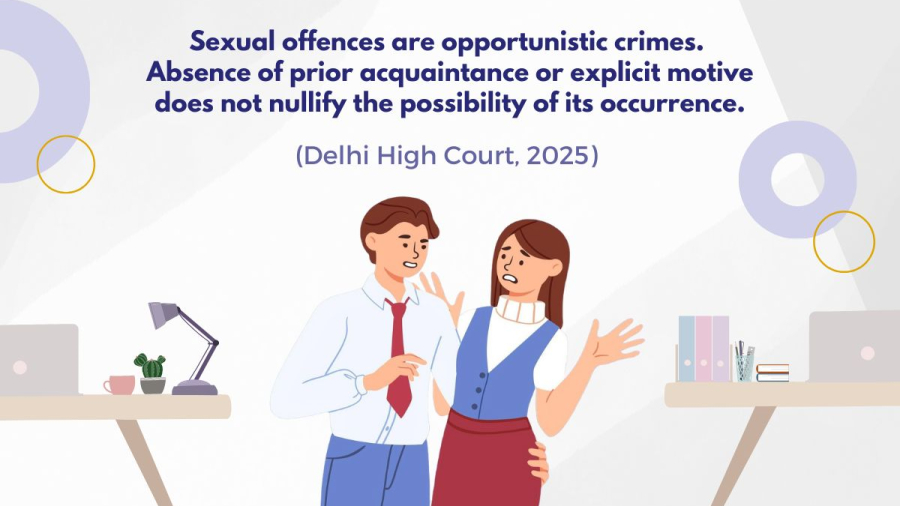
- Sexual offences are opportunistic crimes. Absence of prior acquaintance or explicit motive does not nullify the possibility of its occurrence. The witnesses’ statements support Complainant’s version of the event rather than the Petitioner’s.
- Petitioner himself contended that there was no prior acquaintance between the parties. In such scenario, the contention of false implication becomes absurd and cannot stand.
Court’s Observation and Conclusion
The Hon’ble Court opined that this was a rare case where the bystanders intervened and showcased courage to depose against the Petitioner. The Petitioner’s counsel sought leniency, but the Court did not find itself to be swayed with the plea. It emphasized that girls are not safe even in public places and if it were to observe leniency in the matter it will embolden future perpetrators.
The Court kept in mind the vital issues of women’s empowerment, equality and upliftment and held:
- Petitioner’s actions fulfilled all ingredients of Sections 354 and 509 IPC.
- In absence of any application for Petitioner’s mental and physical disability, in two years of trial, his contentions of unfitness did not stand.
- Petitioner could not establish material error in investigation or in proceedings of Trial and Appellate Court.
In light of the above, the Hon’ble Court disposed the revision petition.
Authored by Ayush Bardhan, Legal Associate