

Case Brief
Parties: S. Ve. Shekher v. Al.Gopalsamy, President & Ors.
Case No.: Crl.O.P.(MD) Nos.11494 & 12163 of 2018 Crl.O.P.Nos.5099 of 2019 & 6211 of 2021 & all connected pending Crl.M.Ps.
Court: High Court of Judicature at Madras
Bench: Honourable Mr. Justice N. Anand Venkatesh
Date of Order: 14.07.2023
Topic: Responsible posting and forwarding of messages on social media
Facts:
The Petitioner, X is an MLA in the Mylapore constituency. X circulated an abusive, derogatory and vulgar comment on his Facebook account which showcases women journalists in a poor light, and the contents were highly derogatory against the press as a whole in Tamil Nadu.
Thereafter, an FIR came to registered under Sections 504, Sec. 505(1)(c), 509, IPC, and Sec. 4, Tamil Nadu Prohibition of Women Act, 2002. Private complaints also came to be filed against X.
X filed a petition under Sec. 482, CrPC to quash the criminal proceedings initiated against him.
Issue
Whether the criminal proceedings initiated against X are liable to be quashed under Sec. 482, CrPC?
Law
| Law | Description |
| Sec. 504, IPC | Intentional insult with intent to provoke breach of peace |
| Sec. 505(1)(c) | Incite any class or community of persons to commit any offence against any other class or community |
| Sec. 509, IPC | Outraging the modesty of a woman |
| Sec. 4, Tamil Nadu Prohibition of Women Act, 2002 | Harassment of women |
X’s Arguments
X filed the petition to quash the criminal proceedings initiated against him on the following grounds:
- X was not the author of the message
- X merely forwarded the message from his Facebook account
- X was not aware of the contents of the message that was sent to him
- X removed the message within a couple of hours on same day after he became aware of its contents
- X tendered an unconditional apology to the concerned woman journalist he had offended and also to the press and media in Tamil Nadu at large
- X gave an interview and expressed unconditional apology and clarified that he had inadvertently forward the message without reading its contents
- X filed an affidavit tendering an apology before the court.
Analysis
The court observed that “…We live in an era where social media has virtually taken over the lives of every individual in the world. A message sent/forwarded in the social media can reach the nook and corner of the world in no time. The ability to communicate is one of the main reasons for the world being ruled by human beings. We are now suffering from a virtual information diarrhoea where everyone is bombarded with messages. Hence, what is exchanged as a message in the social media, can have a very big influence within a short time. That is the reason as to why a person must exercise social responsibility while creating or forwarding a message. This is more so when the person concerned, by virtue of his position, can really influence the minds of the general public. A message sent/forwarded becomes a permanent evidence and it is almost impossible to wriggle out of the consequence that falls out by sending or forwarding a message…”
The court based its final conclusion on the following additional grounds:
- X is an educated person and a well-known figure in State of Tamil Nadu. X has also served as an MLA during the years 2006 – 2011. X has a fan following, and whatever is said and done by leaves an impact. Considering the X’s stature, X should have been more responsible in giving statements and forwarding messages.
- There is a difference between message sent by a normal citizen and by a person with a stature having a large number of followers.
- Merely tendering an unconditional apology will not erase the commission of an offence, or erase the serious impact it has had.
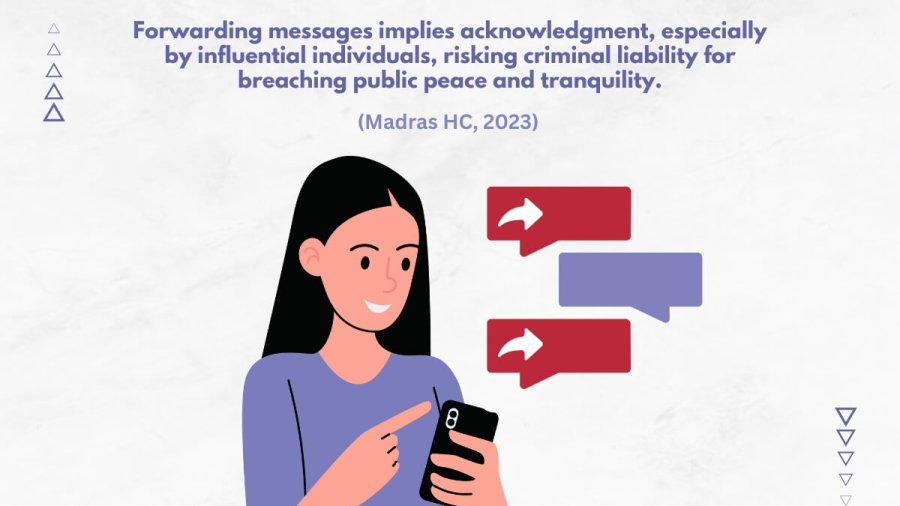
- A person who forwards the message is deemed to have acknowledged its contents.
- The issue as to whether the petitioner had forwarded the message inadvertently or not, is a matter for evidence and such a defence has to be established by the petitioner only during the course of trial.
- X’s actions threatened to breach public place after the circulation of message on social media. It also induced commission of offence against public tranquillity. The repercussions of X’s actions are evidenced from a demonstration in front of X’s house, some violence and a hue and cry across the State. Prima facie case was made out to continue with the criminal proceedings initiated against X.
- It is not possible to quash criminal proceedings in the instant case because it is a not a dispute between two individuals.
Conclusion
For the reasons as mentioned above, the court refused to quash the criminal proceedings initiated against X and clubbed all related matters for trial before the same special court. The special court was directed to disposed of the matter on merits.
By – Divya R, Trainer & External Member, Chief Quality Officer (The Legal Swan)